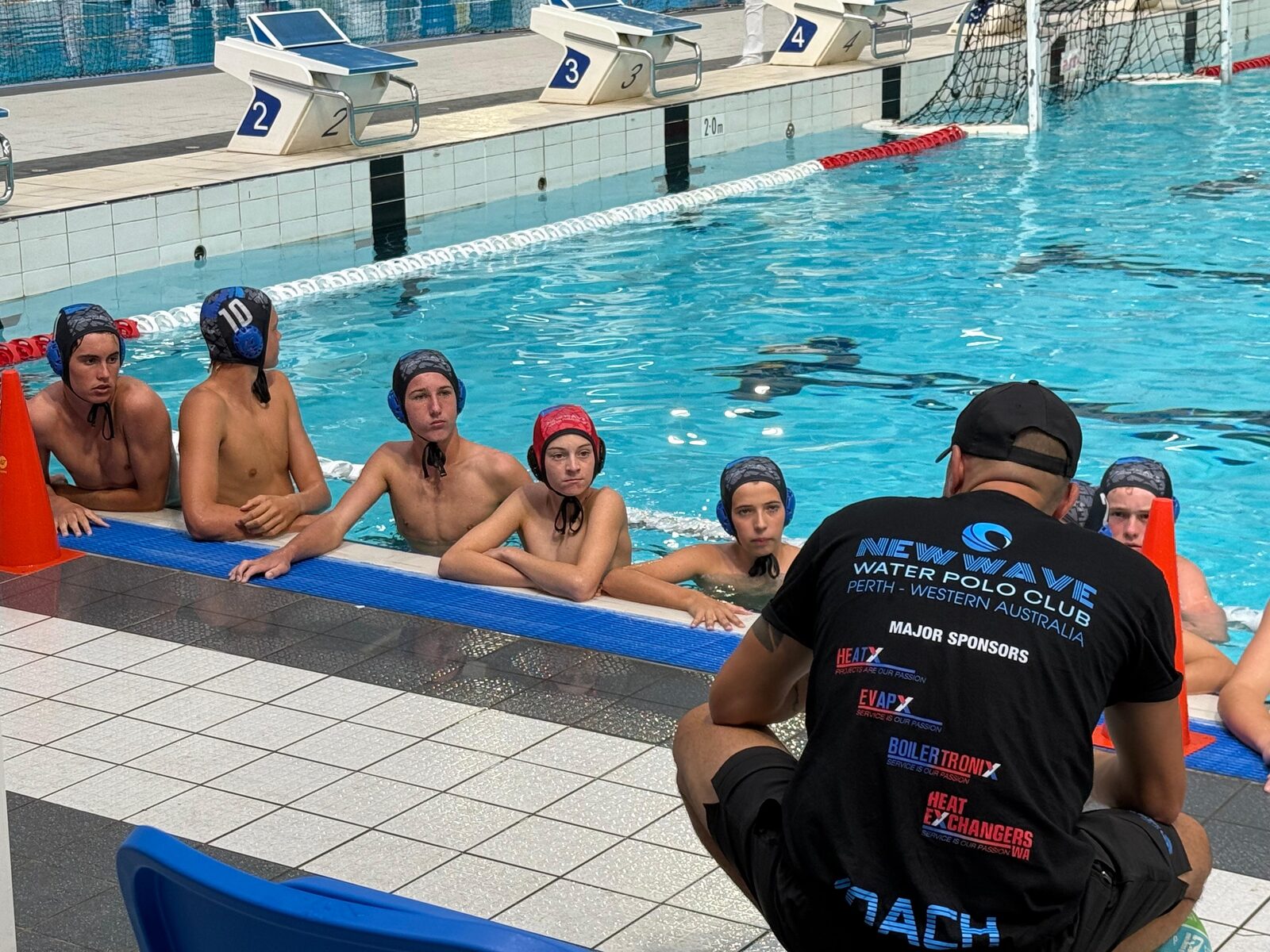
Here's a confession lots of new water polo parents share but rarely say out loud: they watch a whole game and have almost no idea what's going on. Constant splashing, whistles every few seconds, players popping up and down, a scoreline that somehow keeps changing — it can look like beautifully organised chaos.
Good news: water polo makes complete sense once you know a handful of basics. Learn these and you'll go from "why did the whistle blow this time?" to actually enjoying the game your kid loves. Here's the whole sport, from scratch.
The goal of the game (literally)
Strip it all back and water polo is simple: throw the ball into the other team's net more times than they throw it into yours. Think soccer, but in a pool, with your hands. Each goal is worth one point, and the team with the most goals when the final whistle goes, wins.
That's the whole objective. Everything else is just how you go about it.
Who's in the pool
Each team has seven players in the water at once: six "field" players and one goalkeeper. Unlike soccer, field players don't hold fixed positions — they swim the length of the pool constantly, attacking one moment and defending the next. It's one of the fittest sports there is.
The goalkeeper is the exception. They guard the net, stay down their end, and — crucially — are the only player allowed to touch the ball with two hands.
Team sizes and rules are modified for younger players. Our Flippa Ball program uses smaller teams, a lighter ball and simplified rules so young kids can learn without being overwhelmed. Junior teams progress toward full rules as they move up through the age groups.
The rules that surprise newcomers
A few core rules explain almost everything you'll see:
- One hand only. Field players can only hold or throw the ball with one hand at a time. Two hands on the ball (for anyone but the keeper) is a foul.
- You can't touch the bottom. Water polo is played in deep water — players never stand up. They stay afloat using a clever leg movement called the eggbeater (more on that below). No touching the bottom or sides of the pool.
- The ball can't go under. You can't take the ball underwater to protect it — if you're tackled, holding the ball under is a foul.
- Keep moving. Players advance the ball by swimming with it (pushing it along in front of them) or passing to teammates.
The eggbeater: the secret skill
If you watch closely, you'll notice players staying high and still in the water, hands free, for the entire game. They're not magic — they're doing the eggbeater, a circular alternating leg kick that keeps them afloat far more efficiently than normal treading. It's the first thing every player learns, and it's what makes everything else — passing, shooting, wrestling for position — possible. When your child says training was all legs today, this is why.
How a game starts (and restarts)
Each quarter begins with a swim-off: both teams line up on their own goal lines, the referee releases the ball in the centre, and both teams sprint for it. First to the ball wins possession. It's a great burst of action to watch.
After a goal, play simply restarts from the halfway area, with the team that was scored on getting the ball. No big stoppage — the game flows on quickly.
The quarters
A game is played in four quarters, with short breaks between them and a longer half-time. The clock stops whenever the ball isn't in play, so an eight-minute quarter at senior level actually takes longer than eight minutes in real time.
Quarter lengths are shorter for younger age groups than the eight minutes used at senior level, and some junior grades play running time. Your team manager will confirm the exact format for your child's age group.
The shot clock: use it or lose it
A team can't just hold the ball forever. Once you have possession, you get a limited time — the shot clock (or possession clock) — to take a shot at goal. If you don't shoot in time, possession turns over to the other team. At senior level a team gets 30 seconds; this is what keeps the game fast and attacking. Younger junior grades often play with a longer shot clock or none at all, so the little ones aren't rushed.
Fouls: why the whistle keeps blowing
This is the big one for newcomers. Water polo referees blow the whistle a lot — but here's the key insight:
Most whistles are minor fouls that restart play in seconds. The whistle is part of the rhythm of the game, not a full stop.
There are two kinds of foul:
Ordinary (minor) fouls. The most common by far — things like holding the ball with two hands, taking it underwater, or impeding a player who doesn't have the ball. The penalty is small: the other team gets a free throw and play carries straight on. There's no limit to these, and they're not a big deal. This is 90% of the whistles you'll hear.
Major (personal) fouls. More serious contact — holding, sinking or pulling back an opponent. The offending player is excluded: they must leave the field and sit in the "sin bin" area for around 20 seconds (or until possession changes), leaving their team a player down. This is a big deal, because it gives the other team a one-player advantage — a great chance to score. You'll hear parents groan or cheer depending on which team just went a player up.
Three fouls and you're out
Here's a rule worth knowing: a player who commits three major fouls is excluded for the rest of the game and can't return (a substitute takes their place). So players have to balance aggressive defence against the risk of fouling out. If your child comes home talking about "picking up their third," that's what they mean.
The penalty shot
If a major foul is committed inside the 5-metre area and it stops a likely goal, the referee awards a penalty shot — a free shot from a set distance with only the goalkeeper to beat. It's water polo's equivalent of a penalty kick, and it's high drama every time.
The two referees
You'll see two referees, one on each side of the pool, walking up and down the deck. They're the only officials who award fouls, and they use hand signals and pointed arms to show which way play goes and where the ball should be put back in. Once you learn to watch the ref's arm direction, the game gets much easier to follow — the arm points the way the fouled team is now attacking.
Substitutions
Because it's so demanding, players come on and off throughout. Subs can happen after a goal, between quarters, during a timeout, or "on the fly" during play (with the outgoing player leaving from their re-entry area). Don't be confused if you see fresh faces mid-quarter — that's normal.
Watch the game away from the ball
Here's the tip that turns water polo from confusing to gripping: the most important action often happens away from the ball. Players wrestle for position, set screens, and create space under the surface where you can't always see it. The centre-forward battling in front of goal is often where the game is really being won. Once you stop only following the ball, a whole layer of the game opens up.
The bottom line
You don't need to know every rule to enjoy watching your child play. Hold onto these and you're most of the way there:
- Score in the net, most goals wins.
- Six players and a keeper; one hand only (two for the keeper).
- No standing on the bottom — it's all eggbeater.
- Most whistles are minor and play carries on.
- A major foul means an exclusion and a player-up advantage; three and you're out.
- Watch the ref's arm, and watch away from the ball.
The rest you'll pick up game by game — and don't be shy about asking another parent on the sideline "what was that one for?" Everyone was new once. 🌊
Ready to give it a go?
The best way to understand water polo is to get in the pool. From Flippa Ball beginners to seniors, there's a place for every new player at New Wave.
Register for 2026/27 →